
If you only use the free version of one AI chatbot, it’s a fair question: are you missing much? Proofreading a quick email is one of the most common everyday AI tasks, so we took one deliberately messy email, sent the exact same instructions to free ChatGPT, paid Claude, and paid Gemini, and compared the three replies side by side.
TL;DR
All three caught every grammar and spelling mistake in our one test email. The real differences were in behavior: free ChatGPT ignored our “no explanation” instruction and turned the reply into an interactive email-composer card with its own subject line, while paid Claude and paid Gemini returned plain text as asked. Claude and Gemini each took a small liberty with wording (Claude spelled out “ASAP” as “as soon as possible”; Gemini added an em dash). On raw error-catching, free ChatGPT did not fall behind the paid plans in this single run.
How we tested
Date: October 16, 2026. Apps: ChatGPT (Free plan, chatgpt.com, temporary chat), Claude (Pro plan, claude.ai, incognito session, model shown as “Claude Sonnet 5.5” at medium thinking effort), Gemini (Google AI Pro plan, gemini.google.com/app?hl=en, temporary chat, mode shown as “Flash”). Task: proofread and lightly improve one 68-word email containing six deliberate errors (a missing apostrophe, two uncapitalized weekdays, a garbled clause, a typo, and a second typo), with instructions to keep the same meaning, length, and tone, and reply with corrected text only. One run per app, no retries, no custom instructions or memory beyond each account’s defaults. This is a single test, not a benchmark; a different sentence or a longer document could produce different results.
The email we used
We wrote one email with errors a real person might actually make: a missing apostrophe, lowercase weekday names, a typo, a dropped word, and a doubled-up clause that reads awkwardly out loud. Here it is exactly as submitted to all three apps:
Hi Team,
Just wanted to touch base regarding next weeks meeting, its been moved to thursday instead of wednesday due to a scheduling conflict with the vendor. Please make sure you he sent over the updated slides by end of day tommorow so we have time to review them before the call. Also if anyone cant make it please let me no asap so we can reschedule if needed.
Thanks,
Alex
The exact prompt we sent to every app: “Proofread and lightly improve this email for grammar and clarity. Keep the same meaning, keep it about the same length, and keep a friendly but professional tone. Reply with only the corrected email text, no explanation.” Then we pasted the email above.
What each app actually did
Free ChatGPT
ChatGPT’s free plan does not show which underlying model answered a given message; the interface simply gave a reply with no model label visible anywhere in the chat. Instead of returning plain text, it opened an interactive “email” card with its own generated subject line (“Update on Next Week’s Meeting”) and a formatted body, something we did not ask for and that ran past our explicit “no explanation” and implicit “just the text” framing:
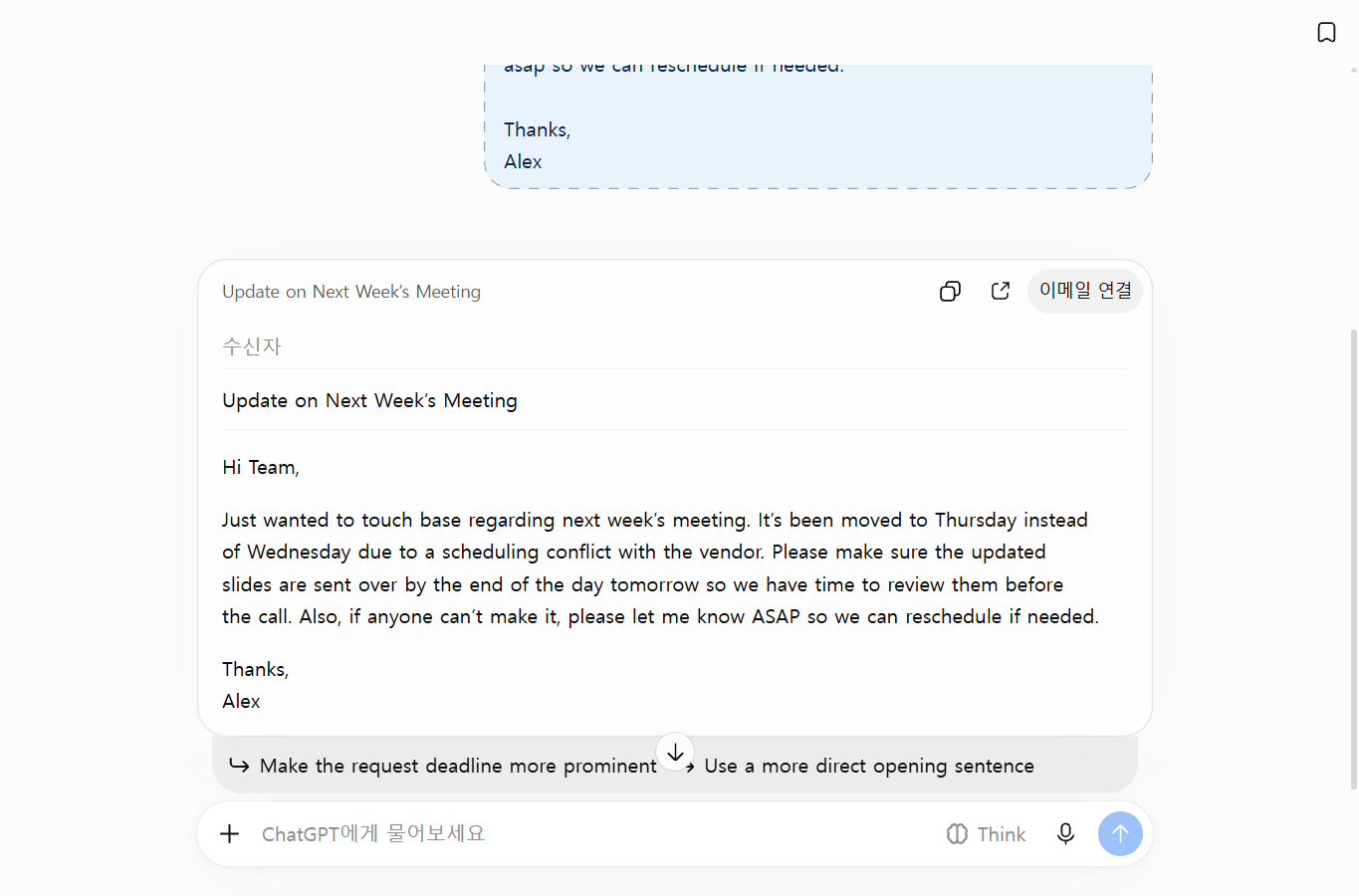
The corrected body text read: “Hi Team, Just wanted to touch base regarding next week’s meeting. It’s been moved to Thursday instead of Wednesday due to a scheduling conflict with the vendor. Please make sure the updated slides are sent over by the end of the day tomorrow so we have time to review them before the call. Also, if anyone can’t make it, please let me know ASAP so we can reschedule if needed.” Every one of our six planted errors was fixed, including the garbled “you he sent over” clause, which it smoothed into “the updated slides are sent over.” It also offered two one-click rewrite suggestions (“Make the request deadline more prominent,” “Use a more direct opening sentence”) that we did not ask for.
Paid Claude
Claude answered as the Sonnet 5.5 model at medium thinking effort, visible directly in the composer bar. It followed the “reply with only the corrected text” instruction exactly, no subject line, no extra formatting, no unsolicited suggestions:

Claude’s version: “Hi Team, I wanted to touch base regarding next week’s meeting. It has been moved to Thursday instead of Wednesday due to a scheduling conflict with the vendor. Please make sure you send over the updated slides by end of day tomorrow so we have time to review them before the call. Also, if anyone can’t make it, please let me know as soon as possible so we can reschedule if needed. Thanks, Alex.” All six errors were fixed. Claude also quietly dropped the word “Just” from the opening line and spelled “asap” out as “as soon as possible,” a small wording choice we didn’t ask for, even though the instructions said to keep the same length.
Paid Gemini
Gemini answered in its default “Flash” mode (the app’s own banner referred to the current generation as “Gemini 4” without spelling out a full version number in the chat itself). Like Claude, it returned plain text with no extra formatting:
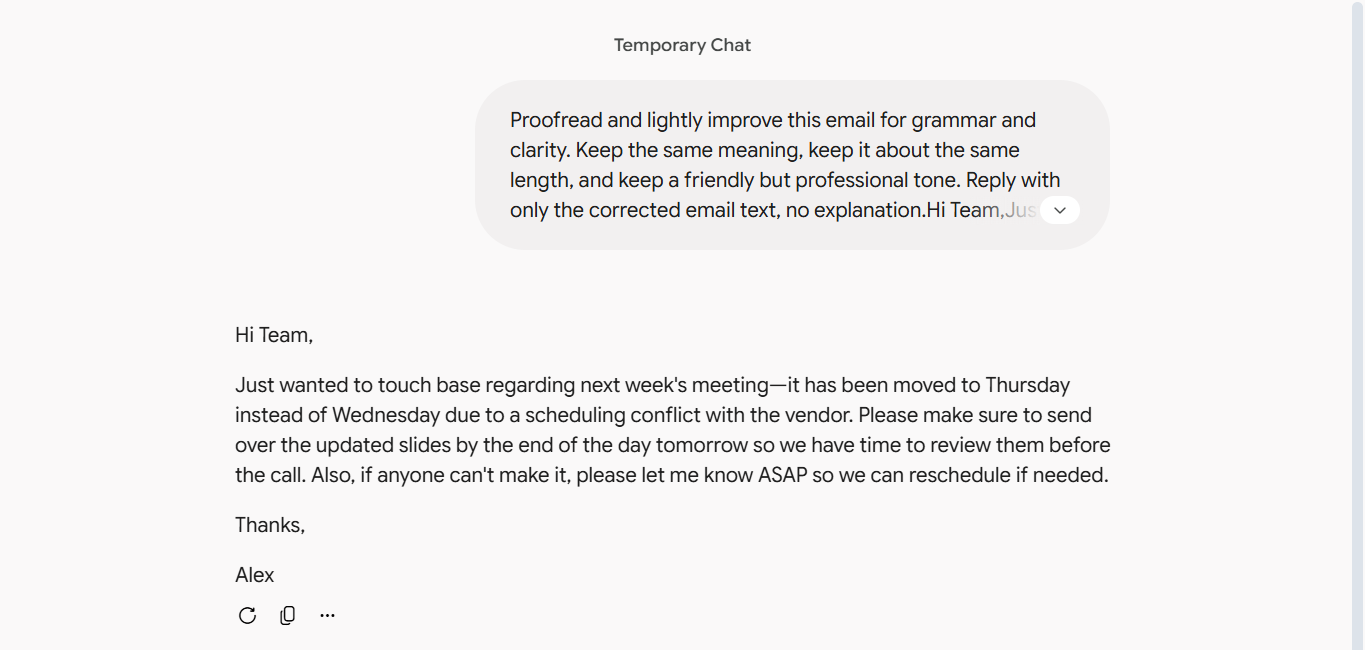
Gemini’s version: “Hi Team, Just wanted to touch base regarding next week’s meeting—it has been moved to Thursday instead of Wednesday due to a scheduling conflict with the vendor. Please make sure to send over the updated slides by the end of the day tomorrow so we have time to review them before the call. Also, if anyone can’t make it, please let me know ASAP so we can reschedule if needed. Thanks, Alex.” All six errors were fixed, and unlike Claude, Gemini kept “ASAP” as an acronym. It added an em dash that wasn’t in the original, a small punctuation change rather than a pure fix.
Side-by-side scorecard
| Check | Free ChatGPT | Paid Claude | Paid Gemini |
|---|---|---|---|
| Fixed “next weeks” → “next week’s” | Yes | Yes | Yes |
| Capitalized Thursday/Wednesday | Yes | Yes | Yes |
| Fixed “tommorow” typo | Yes | Yes | Yes |
| Fixed “cant” → “can’t” | Yes | Yes | Yes |
| Fixed “let me no” → “let me know” | Yes | Yes | Yes |
| Untangled “you he sent over” | Yes | Yes | Yes |
| Followed “plain text only” instruction | No (built an email card) | Yes | Yes |
| Added unprompted wording changes | Minor (two suggestion chips offered, not applied) | Yes (“asap” spelled out, “Just” dropped) | Yes (added an em dash) |
| Model name visible in-app | No | Yes (Sonnet 5.5) | Partial (mode “Flash” only) |
Free ChatGPT
Caught every error. Did not follow the “plain text, no explanation” instruction, instead building a formatted email card with a generated subject line and two rewrite suggestions you didn’t ask for. Good if you want ready-to-send formatting; not ideal if you need exact control over output format.
Paid Claude and Gemini
Both caught every error and returned plain text exactly as instructed, matching the prompt more literally. Each still took a small unprompted liberty with wording (Claude expanded “asap,” Gemini added a dash) rather than a purely mechanical fix.
This was one email, one prompt, one run per app on one day. It is not a verdict on which assistant proofreads “better” in general, and free ChatGPT’s answer could differ on a longer document, a non-English email, or a request it interprets differently. Treat this as one real example, not a benchmark score.
If you chat 50 times a day, what does upgrading actually cost per message?
Catching typos is one thing; whether it’s worth paying for a plan is a separate, very practical question. Here’s what the entry paid tier of each service costs per message if you send roughly 50 messages a day, every day, for a month (1,500 messages). These are official list prices as published on each company’s own pricing page, read on October 16, 2026; we did the division ourselves.
| Plan | Monthly price | Messages at 50/day for 30 days | Cost per message |
|---|---|---|---|
| Gemini AI Plus | $4.99 | 1,500 | $0.0033 |
| ChatGPT Go | $8 | 1,500 | $0.0053 |
| Claude Pro (billed annually) | $17 (equivalent) | 1,500 | $0.0113 |
| Gemini AI Pro | $19.99 | 1,500 | $0.0133 |
| Claude Pro (billed monthly) | $20 | 1,500 | $0.0133 |
| ChatGPT Plus | $20 | 1,500 | $0.0133 |
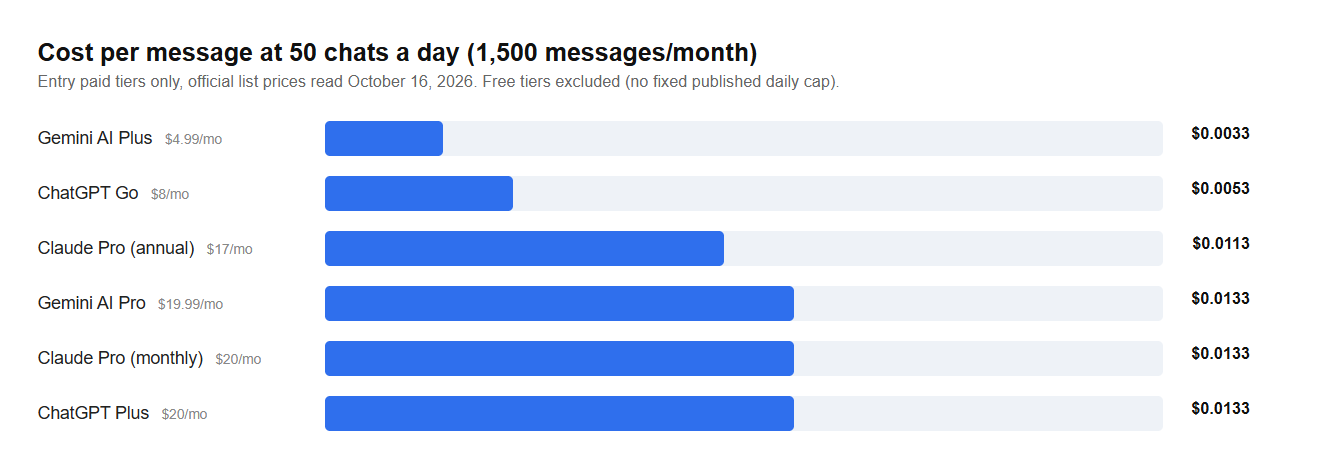
We left the free plans out of this table on purpose. None of the three companies publish one fixed, guaranteed daily message cap for their free tier on the pricing page; the actual limit you get can vary with load and model, so a per-message cost for “free” isn’t a real, comparable number the way a flat monthly fee is. If you’re close to a free plan’s limit most days, that’s the real trigger to look at a paid plan, not a theoretical per-message price.
At 50 chats a day, every paid plan here lands under one and a half cents per message, and the cheapest entry tier, Gemini AI Plus at $4.99, comes out to roughly a third of a cent per message. The three $20-ish “standard” tiers (Claude Pro monthly, Gemini AI Pro, ChatGPT Plus) land at the same $0.0133 per message simply because they’re all priced the same; the actual decision between them comes down to which model and features you want, not the per-message math.
FAQ
Does this mean free ChatGPT is just as good as paid plans?
Not as a general claim. It means free ChatGPT caught the same errors as paid Claude and Gemini in this one proofreading test. Paid plans unlock other things this test didn’t touch: higher usage limits, longer context windows, and in Claude’s and ChatGPT’s case, coding tools and higher-effort reasoning modes.
Why didn’t you compare the free tiers of Claude and Gemini too?
The user accounts available for this test were free ChatGPT, paid Claude, and paid Gemini, which happens to mirror a common real setup: people often keep one free account and pay for whichever assistant they’ve settled into. A three-way free-tier comparison is a reasonable follow-up test.
Why did only ChatGPT build an email card instead of plain text?
We can only report what we observed: ChatGPT’s free-tier interface appears to auto-detect “email-shaped” requests and route them into an interactive composer tool, even when the prompt explicitly asks for plain text only. Claude and Gemini did not do this with the identical prompt.
Is Claude Sonnet 5.5 the only model Claude Pro offers?
No. Claude Pro can switch between models including Opus and Haiku; Sonnet 5.5 at medium effort was simply the default selected when this test ran.
Where do the pricing numbers come from?
Each company’s own pricing page (chatgpt.com/pricing, claude.com/pricing, and Google’s Gemini/Google AI plans page), read on October 16, 2026. Prices and plan names change without notice, so check the current page before subscribing.
Researched and drafted with AI assistance from the sources linked above; any tests described were run by MeasuredRun on the date stated. Published by MeasuredRun. How we use AI.